Archive | January, 2013

When Will We Stop Blaming the White Man?

16 Jan

post 2 images

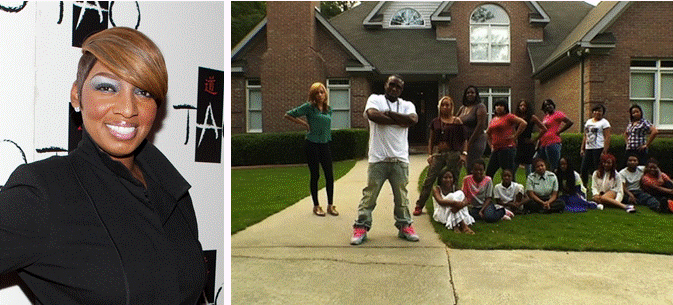
Thanks to the NAACP and everyone who petitioned, Oxygen recently cancelled that triflin show that made a mockery of Black households All My Babies’ Mamas.

Since the controversy around the show, many people have asked who is responsible for the negative portrayal of African Americans on reality TV. The victory over All My Babies’ Mamas is just the beginning. Shows like Basketball Wives and Real Housewives of Atlanta have similar degrading portrayal. When housewife Evelyn takes off her hearing and starts throwing wine bottles at another housewife, or when Nene Leakes interrupts a party to get in someone’s face and tell them off, it portrays Black women as savage, uneducated creatures who don’t know how to act, and reinforce the same stereotypes we’ve tried to get away from. Yet, there’s hardly any fuss over these shows.

So who’s to blame for the horrifying image of Black women on reality TV?

Many like to point fingers at the networks. That’s what we did with All My Babies’ Mamas.

According to an article in Essence, networks create drama on these shows. They cut and edit so that the focus is on fighting and hostility. The normal, everyday lives of the housewives (or wherever else) are often cut out. Degrading our image is encouraged in order to increase ratings.

In an interview Nene Leakes, from Real Housewives of Atlanta told Essence Magazine, “We work for a White man who wants blood out of you. He makes you say shit you don’t want to say and if you don’t, he screams and scratches.” Similarly, Shaunie O’Neal, producer of Basketball Wives said that she went to the network saying the show needed more positive aspects but “the problem is that at the end of the day, the network decides what it wants.”

No. I don’t buy it. I understand that networks sacrifice our dignity for ratings. So what then? Everyone’s off the hook? We just let the network abuse the image of Black women. We allow them to portray us as uncivilized and irrational creatures? When are we going to stop blaming the White man?

If these women cared so much about their image, if they really wanted change, why not walk away? Or is the fame worth selling out?

Sil Lai Abram, writer from The Grio suggests that the viewers are to blame. She says we must stop supporting shows that perpetuate horrifying stereotypes of us.

I agree. So I didn’t pick up a copy of Ebony when they put Nene Leakes on the cover in January. I don’t support products from the housewives (books, fragrances, clothing lines etc.). I don’t care if their products are “Black-owned” if they make their profit by acting like fools on television and displaying atrocious images of Black women.

Everyone who participates is to blame for perpetuating these stereotypes. The network, the TV stars, and the viewers/consumers all play a role. But change is not impossible. If we stop supporting these shows, support petitions similar to the one against All My Babies’ Mamas, and urge media that is supposed to support Black women, like Essence and Ebony, to also stop supporting these programs, we can see a change in the way Black people are portrayed on TV.

See Sil Lai Abram’s article

We Are All Bitches, Hoes, and Tricks (You are NOT exempt)

9 Jan

Maria Llyod, writer from Reason4Rymes, has split Black women into 2 classes.

She says:

“I must admit that I don’t have the slightest interest in how rappers view black women. Why? Because they’re not talking about me. In fact, they’re not talking to me either because I don’t listen to their music…The women the rappers are addressing are the women who use the word ‘b*tch’ as a term of endearment. They are the women who have no respect for and/or knowledge of black history. They are frequently making poor decisions regarding their finances and their sexual behavior.”

Lloyd goes on to talk about the divide between educated and uneducated black people. She defines “educated” not solely as schooling, but as “the ability to think for yourself with conclusions drawn from research and experience.” In her opinion, rappers talk about uneducated women.

I shook my head at every word on that page.

First of all, women who say rappers “aren’t talking about them” are kidding themselves. They are talking about all women, especially Black women.

Now, rappers may differentiate between “ratchet pussy” (Juicy J), “bad bitches,” “independent women,” and whatever else they like to call us. They are not singling out or excluding certain women in their lyrics. It doesn’t matter if you’re educated, or whether or not you listen to their music. If you are a woman, you fall into one of their many categories.

The degradation of women in the music industry is not an “uneducated” woman’s problem. It is (or should be) a concern for all Black women. It is our image that is being dragged through the mud for the entire world to see. Those are our bodies that appear in music videos. We are the bitches, hoes, and tricks that they are referring to.

Black women’s reputation is especially at risk. The image rappers put forth is absorbed in the eyes of other ethnic groups. Society doesn’t always take the time to differentiate between “educated” and “uneducated” Black people. I can’t tell you how many nonblack people have asked me ignorant questions like “Can you dance like the girls in the music videos?” or “Have you ever been to Compton?” or “Do you like Lil Wayne?” simply because of the color of my skin.

When an “educated” Black woman walks into a room, people may draw conclusions from the way that she dresses and presents herself. They may think she is well-mannered or high class (or whatever their words may be) but that doesn’t mean their perceptions of all Black women have changed just because one “educated” woman walked into that room. If anything, they may think “Oh, she’s one of the good ones,” like many racists like to say.

And it shouldn’t be like that. I shouldn’t have to prove that I am “educated” or “one of the good one’s” (both definitions pretty much mean the same thing). The image of Black women should be changed so that when I am in front of any audience, they are not comparing me to horrifying images of Black women they see on TV.

People categorize and stereotype all the time. The only way to change the stereotype of Black women is with a united front. Not only must the “educated” women boycott degrading music, as Lloyd says later in her article, but everyone must push for a change in the music industry.

See Maria Lloyd’s article

New Year’s Res: A Womyn’s Worth

5 Jan

I usually hate New Year’s resolutions, so I don’t make them. But for the past few years, I’ve had 2 mottos that I try to live by: Say What’s Real and Do What I want.

This year, I’m going to focus mostly on Say What’s Real, which is why I’m launching A Womyn’s Worth as my New Year’s resolution.  

The idea for this blog began with research for my thesis, which is about the image of Black women in hip hop. But no one needs to do research to know that the image of Black women in hip hop (and most other media) is an image that has been degraded, dragged through the mud, and sold out to the highest paying men at top record labels.

The research gave me a new perspective that allowed me to see this topic with new eyes. I realized that the degraded image of women in hip hop is one that should be disputed until it is changed. But the majority of hip hop fans ignore the words. We listen to the lyrics and sing along as if what we are saying isn’t harmful. We say stupid shit like “oh he’s not talking about me” whenever we hear rappers call us hoes (I’m gonna tell you why THEY ARE TALKING ABOUT YOU in my next post). We go to parties and clubs and do exactly what they tell us to do: we bend over, we make it clap, and we pop our pussies. And somehow, all that’s become okay. It’s the norm.

That’s why I’m launching A Womyn’s Worth

I’m entering into the conversation of women and men who are sick of the degrading images of Black women. Because I know that A WOMAN IS WORTH so much more than what’s in mainstream music,  films (especially Tyler Perry’s films), and the media.

In addition, I’ll blog about topics related to feminism, style, culture, and everyday life.

A Womyn’s Worth Objectives