How to Change the Image of Women in Hip Hop

19 Mar

How to Change the Image of Women in Hip Hop: from Powerlessness to Activism

Lately I’ve been hearing a collective complaint regarding the image of black women in the media: There’s nothing we can do about it.

In an interview with Clear Channel (a large mass media company), activists from an organization called FAANMAIL explained that people don’t feel empowered enough to change hip hop’s portrayal black women. People don’t feel like they can’t make a difference because of the large entities they are up against.

Yes, the task will be challenging.

When challenging misogyny and racism in the media, you’re up against powerful companies with billions of dollars, that control what airs on TV and the radio, and employ several destructively influential hip hop artists, reality TV stars, and insatiable businessmen that all act as a collective Goliath.

That’s why people don’t try.

But we need to get out of this powerless state of mind. It’s not the government, the industry, or “the system,” that suppresses our voice—it’s the belief that we can’t do it that stagnates progress. Our feelings of powerlessness are partly the reason the image of black women in the media is what it is: an uneducated, hypersexed, “big booty hoe” with no concept of manners or self-respect.

However, change is not impossible. People have already made tremendous strides. Several organizations, such as FAANMAIL and Truth in Reality, work to change the image of black women in the media. In addition, we’ve all heard about how one writer, Sabrina Lamb, started the petition that canceled the show All My Babies Mamas. This is just the first step.

More work must be done—and it cannot solely happen online. It’s great to raise awareness through petitions on Change.org and social media, but armchair activism cannot replace live effort.

Activism online is too easy, and as the Harvard Crimson puts it, “Effective activism that creates lasting change takes effort and is often very frustrating. In fact, if an action is shiny, prepackaged, easy, and does not require any research or other sort of effort on the doer’s part, that is probably a sign that it is not going to be highly effective. If we hope to make a difference, it is essential that we are critical of such representations.”

In other words, real activism requires you to leave your computer screen and get your ass off of the couch (Ironically, I need to take my own advice. Blogging is a start; but, it’s not enough).

Here are some ideas on how to get active:

  • Connect with like-minded individuals.
  • Partner with organizations that are already doing the work
  • Host public rallies to show others there is a group that cares about the issue.
  • Use social media to its fullest extent
  • Involve local newspapers to spread the word
  • Get corporate sponsors (I know this may be easier said than done…yet still possible)
  • Try focusing on what changes you would like to see in the media (explaining what you don’t like is good, but giving examples of what you would like shows potential)

Of course, all of this will not happen overnight. But its the perseverance, dedication, and passion that gets things done.

“No work is insignificant. All labor that uplifts humanity has dignity and importance and should be undertaken with painstaking excellence.”

~Dr. Martin Luther King Jr.

Recommended Link: http://faanmail.wordpress.com/2013/03/12/talk-back-our-conversation-with-clear-channel-about-community-concerns/
Am I Black Enough?

12 Mar

I didn’t listen to Tupac growing up, I’ve never seen any of the Friday movies, and I can’t twerk.

Only a priest at Confession could get me to admit all of that. I was ashamed to say so in fear that my “Authentic Black Girl Card” would be revoked.

The other day I picked up Patricia Collins’ Black Sexual Politics.* She explains how mass media “blurs the lines between fact and fiction” on the image of Black people, and because of that, some representations of Black people have become commonsense “truths,” when really they are all stereotypes created by sources outside of our communities.

Sadly, we adopt these stereotypes and hold one another to them. We are expected to “act Black,” and we ostracize those who do not.

At young ages, Black children who are raised in Black communities learn what it means to be “authentically” Black. I picked up on in the 3rd grade. By that time, I’d learned to speak a certain way, pronouncing or not pronouncing certain syllables.

I often felt the need to hide my social class –so I avoided telling people that I was from Ladera Heights (a wealthy Black neighborhood in LA) because in elementary school, being from Inglewood was more acceptable.

In middle school I learned to dance how Black girls are expected to dance: bent over in front of a guy, moving my ass on his crotch to the beat. I was never good at it. But imagine my joy when I realized I could Crip-walk. I thought to myself, “Yes! Evidence that proves I’m really Black!

But despite all my attempts, I was still labeled whitewashed—and I still am (you know it’s bad when your Korean friends say it).

The “problem” is: I don’t fit the stereotype of what the media says a Black woman should be. The societal definition of what it means to be Black (which is dangerously similar to the racist19th Century beliefs of colonial powers) is how some of us define ourselves.

And those definitions are damaging. For example, Collins tells us, “Black men in pursuit of booty calls may appear to be more authentically ‘Black’ than men who study, and the experiences of poor and working class Black men may be established as being more authentically Black than those of the middle-and upper-middle class African American men” (Collins 151).

So I’m not going to define myself by racist standards of what it means to be Black—because you can’t be genuine if others are still defining who you are.

Lil Wayne and Black History Month

26 Feb

At the close of Black History Month, I want share 2 images I found on the internet that display why this month is so crucial. (they’re tiny so you may have to click on them).

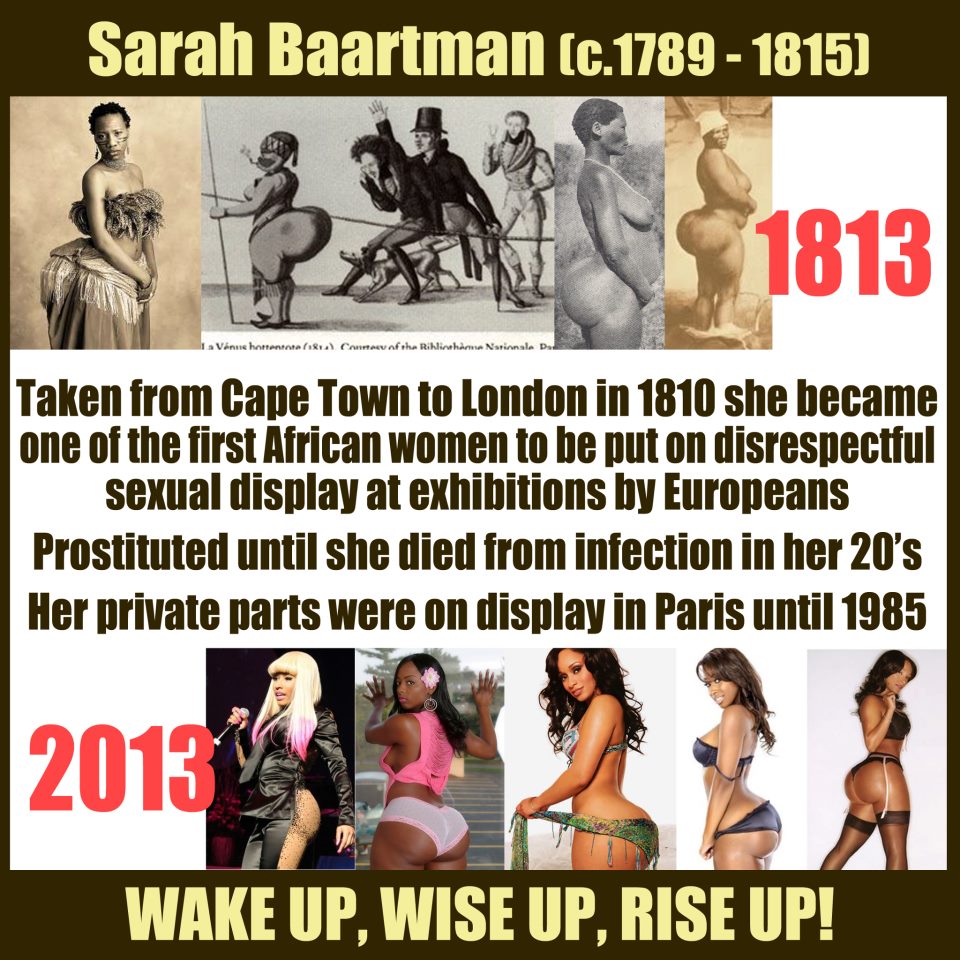
21st century Venus Hottentot

I found this image on Facebook yesterday, but  I’d first learned of Saartjie Baartman (Sarah is her English name) at the very beginning of this month while doing some research for my thesis*. Saartijie was put display in London as a human freak show, and called the Venus Hottentot. During my research, I read “How Not to be a 21st Century Venus Hottentot,” where writer Fatima N. Muhammad compares video girls and hyper-sexed female rappers to Venus Hottentot, as they too are examined and put on display for their body parts.  She explains that mainstream hip hop has adopted racist 19th century ideas.

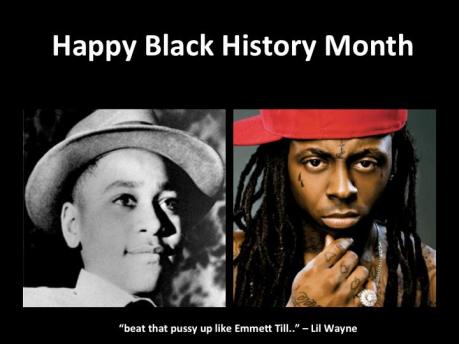
I don’t think anyone could argue with that after Lil Wayne’s offensive comment about Emmit Till in his song “Karate Chop Remix.”

Lil Wayne Emmit Till

I found this picture on Faanmail’s site (Thanks FAANMAIL! I love your posts).

Since the song leaked, the line “beat that pussy up like Emmit Til,” has been pulled from the song, and Till’s family has asked the rapper for an apology. Wayne has yet to respond. I’m not holding my breath. Anyone who thought putting that line in a song was ok has no respect for the Civil Rights Movement and isn’t real enough to own up to their mistakes.

Someone needs to strap him to a chair and make him watch all 14 hours of Eyes on the Prize.

But I’m not one bit in shock that Wanye would say something like that. It’s not the first racist thing to come out of a rappers mouth.

And it’s hardly different from his song “Mrs. Officer,” when he says, “Rodney King baby yeah I beat it like a cop.”

Once again he managed to disrespect women and diminish the importance of a tragic event in black history in just a few short words.

This line from Lil Wayne and the image of Saartijie Baartman portray the necessity for Black History Month and year-round community education, as history has already began to repeat itself.

Further Reading

Muhammad, Fatimah. “How NOT to Be a 21st Century Venus Hottentots.” Home Girls Make Some Noise: Hip Hop Feminism Anthology. Ed. Gwendolyn D. Pough, Elaine Richardson, Aisha Durham, and Rachel Raimist. Mira Loma: Parker, LLC, 2007. 115-140. Print.

http://faanmail.wordpress.com/2013/02/21/talk-back-lil-wayne-epic-records-and-sony-entertainment/

*My thesis is on the image of black women in hip hop. I explore how male rappers talk about vaginas in comparison to how woman rappers do. In addition, I look at how a rapper’s ethos is built on a racist and sexist ideology. It has to be at least 25 pages due in early April. Clocks Ticking!