My Top 10 Novels for Black History Month

12 Feb

(Written by incredible women writers)
Novel image

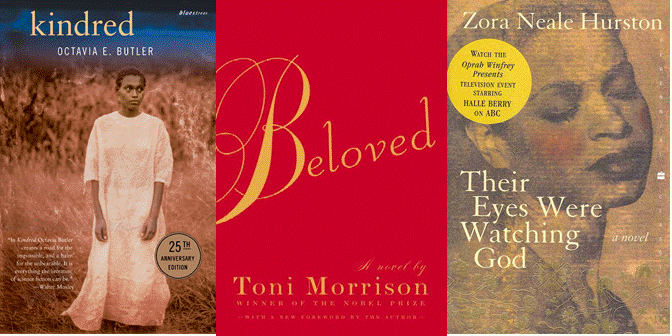
1.      Beloved (Toni Morrison)

This Nobel Prize winning novel touches on issues of stereotypes in the media, a mothers’ limitless love, and the dehumanizing aspects of middle passage and slavery. A desperate mother slays her daughter in an attempt to escape her slave master; however, the daughter never dies. Her ghost rises and takes on human form to haunt the town. Trust me: “This is not a story to pass on.

2.      Parable of a Sower (Octavia Butler)

Parable of a Sower throws you into a futuristic dystopian U.S., where companies, in addition to people are slave masters. Protagonist Lauren, must find a safe haven after her family was murdered and her neighborhood was burned by “Paints,” the drug addicts who take pleasure in setting fires watching everyone and everything burn. Lauren is hyperempathic, meaning she can feel others pleasure and pain. In a time where there is mostly pain, Lauren must dodge the Paints, slave masters, and thieves on the road, while trying to overcome her hyperempathy.

3.      Kindred (Octavia Butler)

If you’re interested in time travel, this is your book. Dana involuntarily travels back to the antebellum South, to meet her slave master great great grandfather, and slave great great grandmother. She must ensure that her great great grandpa slave owner lives long enough to father the next generation of her family. Periodically throughout the week Dana is summoned from Los Angeles in 1976 to early 19th century Maryland. During these trips, she must endure the dangers of being a slave and a woman—and there are many.

4.      The Farming of Bones (Edwidge Danticat)

Danticat’s fictional account of The Parsley Massacre of 1937 will fill anyone’s craving for Haitian history. The story follows the main character’s attempt to travel from the Dominican Republic to Haiti to escape the troops of President Trujillo, who have been ordered to slaughter all Haitians in the DR. When she makes it to Haiti, she must come to terms with all emotional pain, the violence, and all the people she lost.

5.      A Small Place (Jamaica Kincaid)

This is actually a nonfiction essay turned into a book, where Kincaid discusses history and life in Antigua. She allows the reader to take the seat of a vacationer as she takes you on a tour while describing the effects of British imperialism on the island.

6.      Song of Solomon (Toni Morrison)

Milkman, given that name for reasons you’ll later discover, goes on a journey to find gold that his father once discovered in a cave next to a dead man. On his trip, Milkman discovers that he is a descendant of flying African slaves, one of whom supposedly flew back to Africa. “If you surrender to the air, you can ride it.”

7.      The Bluest Eye (Toni Morrison…Can you tell she’s my favorite?)

The Bluest Eye is the story of how a little Black girl goes insane by feeding into what Toni Morrison calls “The Mettanarrative,” which is the white man’s view of the world. It’s not a novel with a happy ending, but it’s one that causes us to question our society’s standards of beauty and it claims the lives of many young girls.

8.      All God’s Children Need Traveling Shoes (Maya Angelou)

This awesome autobiography of Maya Angelou tells her journey to Ghana, where she learns much about Ghanaian culture, dates Ghanaian royalty, and walks along the many places where people were stolen or sold into slavery, just before they boarded the slave ships.

9.      Their Eyes Were Watching God (Zora Neal Hurston)

Through three marriages, Janie Crawford, discovers herself and her desire to live independently and find love. It is a tale of a southern Black woman’s journey through poverty and life trials to confidence, independence, and self-love.

10.   I Know Why the Caged Bird Sings (Maya Angelou)

I have to confess that I haven’t read this one yet (Yes, I am very ashamed to say so). The reason being is that I know it is an emotional read.

A few of these novels are actually very emotional reads. That’s why they’re on my Black History list. People of African descent have a heartrending yet enriching past. A few of these novels may bring you to tears. They do what good novels are supposed to do: inform, entertain, uplift, and make us better people. These are the writers that inspire us to tell our own stories, recollect our past histories. They add to the many stories that make Black History Month what it is, a time to remember our past, and be inspired by it.
Are we taking the Volkswagen commercial too seriously?

5 Feb

VW Comercial pic

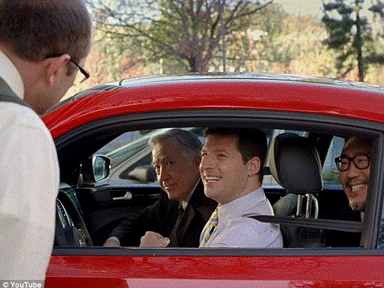
There has been much commotion about the new Volkswagen commercial, where a white guy speaks with a Jamaican accent.

Many say the commercial is mocking black people; New York Times’ Charles Blow called it  “blackface with voices.”

Though I personally wasn’t offended, my islander friends might have a problem with it.

My thing is: People quickly become outraged when the teeniest bit of insensitivity occurs from outside sources, but what about when one of our own is shamelessly racist?

Why is Kanye allowed to say, “You know white people—get money don’t spend it. Or maybe they get money, buy a business. I’d rather buy 80 gold chains and go ignant…blame it on the pigment.”

Why can A$AP Rocky say, “They say money make a nigga act niggerish. At last a nigga nigga-rich.”

Why is Lil Wayne entitled to decide, “Beautiful Black woman, I bet that bitch look better red.”

Sure, maybe the commercial was mocking a Jamaican accent. Sure, maybe it was a little insensitive. But when Kanye declares the pigment of his skin makes him ignorant— when Lil Wayne decides a woman lighter complexion is more beautiful than a dark skin woman —when A$AP Rocky says Black people act niggerish when they become wealthy, but it’s justified because they’re rich—suddenly, that commercial doesn’t seem so significant.

Perspective people—that’s all I’m asking for.

Is it because theses rappers are Black that they are allowed to say racist things? Is it not racist or less hurtful because they are Black?

I don’t think so. If anything it’s worse.

But the absolute worst part, though, is that they get away with it. We don’t call them out. How can we criticize companies for being insensitive when we do not shame people of color for their own blatantly racist remarks?

It’s hypocritical—don’t you think?

When Will We Stop Blaming the White Man?

16 Jan

post 2 images

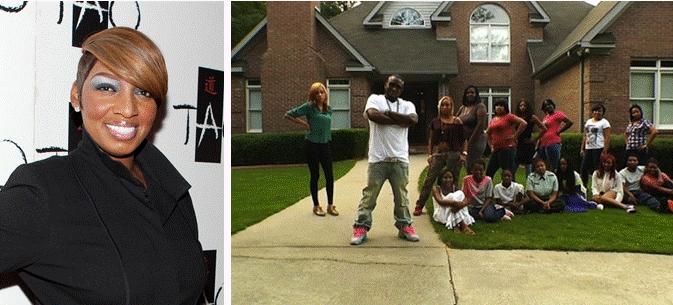
Thanks to the NAACP and everyone who petitioned, Oxygen recently cancelled that triflin show that made a mockery of Black households All My Babies’ Mamas.

Since the controversy around the show, many people have asked who is responsible for the negative portrayal of African Americans on reality TV. The victory over All My Babies’ Mamas is just the beginning. Shows like Basketball Wives and Real Housewives of Atlanta have similar degrading portrayal. When housewife Evelyn takes off her hearing and starts throwing wine bottles at another housewife, or when Nene Leakes interrupts a party to get in someone’s face and tell them off, it portrays Black women as savage, uneducated creatures who don’t know how to act, and reinforce the same stereotypes we’ve tried to get away from. Yet, there’s hardly any fuss over these shows.

So who’s to blame for the horrifying image of Black women on reality TV?

Many like to point fingers at the networks. That’s what we did with All My Babies’ Mamas.

According to an article in Essence, networks create drama on these shows. They cut and edit so that the focus is on fighting and hostility. The normal, everyday lives of the housewives (or wherever else) are often cut out. Degrading our image is encouraged in order to increase ratings.

In an interview Nene Leakes, from Real Housewives of Atlanta told Essence Magazine, “We work for a White man who wants blood out of you. He makes you say shit you don’t want to say and if you don’t, he screams and scratches.” Similarly, Shaunie O’Neal, producer of Basketball Wives said that she went to the network saying the show needed more positive aspects but “the problem is that at the end of the day, the network decides what it wants.”

No. I don’t buy it. I understand that networks sacrifice our dignity for ratings. So what then? Everyone’s off the hook? We just let the network abuse the image of Black women. We allow them to portray us as uncivilized and irrational creatures? When are we going to stop blaming the White man?

If these women cared so much about their image, if they really wanted change, why not walk away? Or is the fame worth selling out?

Sil Lai Abram, writer from The Grio suggests that the viewers are to blame. She says we must stop supporting shows that perpetuate horrifying stereotypes of us.

I agree. So I didn’t pick up a copy of Ebony when they put Nene Leakes on the cover in January. I don’t support products from the housewives (books, fragrances, clothing lines etc.). I don’t care if their products are “Black-owned” if they make their profit by acting like fools on television and displaying atrocious images of Black women.

Everyone who participates is to blame for perpetuating these stereotypes. The network, the TV stars, and the viewers/consumers all play a role. But change is not impossible. If we stop supporting these shows, support petitions similar to the one against All My Babies’ Mamas, and urge media that is supposed to support Black women, like Essence and Ebony, to also stop supporting these programs, we can see a change in the way Black people are portrayed on TV.

See Sil Lai Abram’s article