Tag Archives: Black History Month

Top Blogs to Follow During Black History Month

5 Feb

20010129 BLACK HISTORYHappy Black History Month Everyone! Last year, I created your Top Reads for Black History Month—but I know some of y’all didn’t even bother to turn a page during the entire month (yes, I’m shaming you). You can check out that list if you need some reading suggestions. However, if you need something short and sweet, might I suggest a few blogs and sites that may have some of the most interesting content during the month:

Racialicious-the intersection of race and pop culture.  I always turn to Racialicious when there’s a race-related debate going on. Their writers and editors are on point and always present perspectives that other news/blog outlets gloss over. (And I’ve written for them before so I’m definitely a fan!)

Twerked presents great conversation on women of color, their sexuality, their interests and their love of hip hop. Twerked gives an educated black feminist view on twerking. So you can stop watching those stupid twerking segments on nighttime news; this blogger’s got you covered.

The Gradient Liar -Black Women + art, media, social media, socio-politics, and culture. If you’re trying to upgrade your knowledge of womanist politics during this month, check out The Gradient Liar.

The Crunk Feminist Collective– The name is pretty self-explanatory. The site is a place for hip hop generation feminists to express their thoughts.

Colorlines -Though not technically a blog, Colorlines is a daily news site where race matters. Check them out for almost any topic of your interest.

Media Diversified tackles the lack of diversity in UK media. The organization has an army of writers on worldwide topics and news.

Rap Rehab is a popular site for music-lovers that want to know more about race and politics in the music industry.

Hood Feminism– creators of several trending hashtags on twitter (#fasttailedgirls, #solidarityisforwhitewomen, and more), Hood Feminism is bound to stir up some good conversation during Black History Month on both twitter and the blog.

TransGriot provides news, opinions, and commentary from a proud African American transwoman who is an award-winning blogger.

And of Course: A Womyn’s Worth will bring your weekly black history month insight when you need it. On the days when I’m not posting, check out some of those blogs I mentioned above.

P.S.: if you’re looking for some Black History Month comedy—watch SNL’s “28 Reasons to Hug a Black Guy.” I couldn’t stop laughing.
Lil Wayne and Black History Month

26 Feb

At the close of Black History Month, I want share 2 images I found on the internet that display why this month is so crucial. (they’re tiny so you may have to click on them).

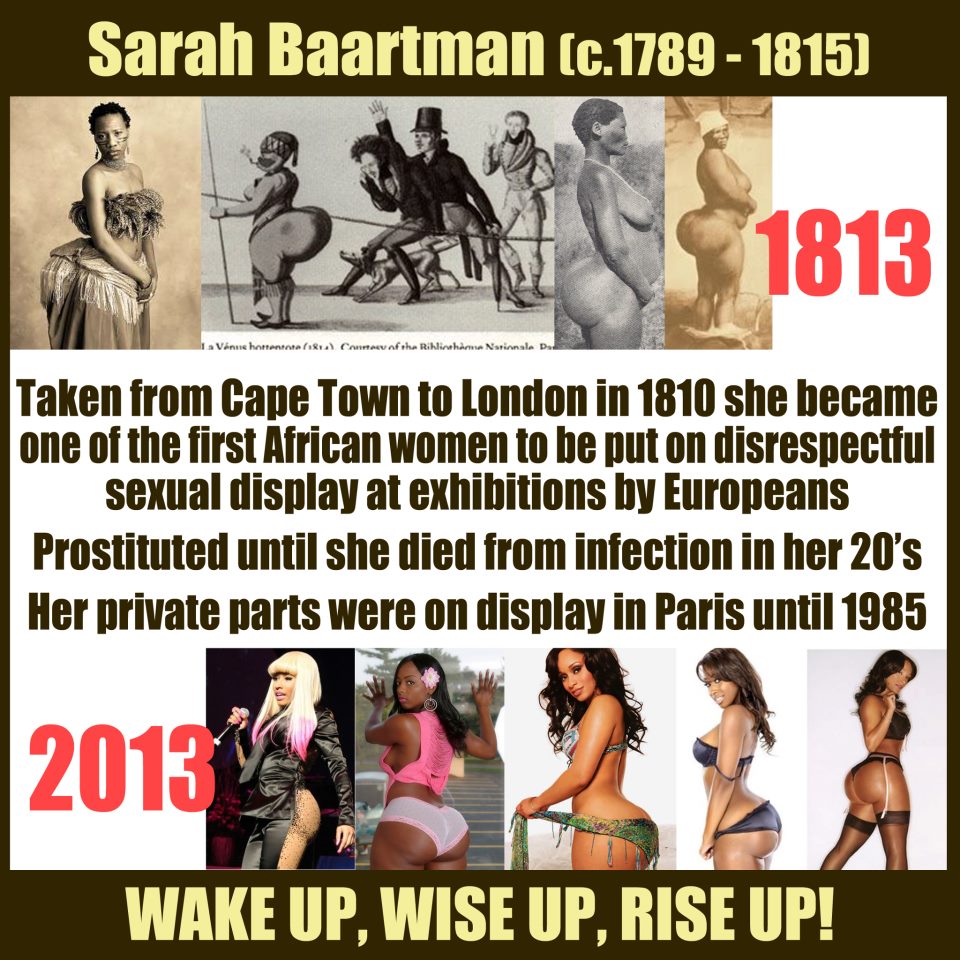
21st century Venus Hottentot

I found this image on Facebook yesterday, but  I’d first learned of Saartjie Baartman (Sarah is her English name) at the very beginning of this month while doing some research for my thesis*. Saartijie was put display in London as a human freak show, and called the Venus Hottentot. During my research, I read “How Not to be a 21st Century Venus Hottentot,” where writer Fatima N. Muhammad compares video girls and hyper-sexed female rappers to Venus Hottentot, as they too are examined and put on display for their body parts.  She explains that mainstream hip hop has adopted racist 19th century ideas.

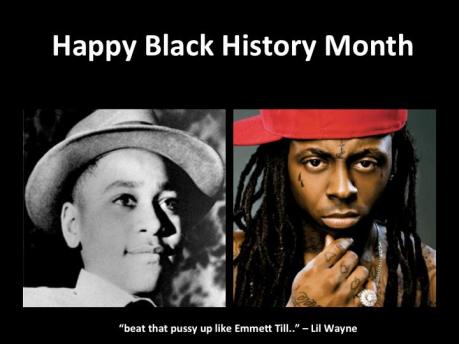
I don’t think anyone could argue with that after Lil Wayne’s offensive comment about Emmit Till in his song “Karate Chop Remix.”

Lil Wayne Emmit Till

I found this picture on Faanmail’s site (Thanks FAANMAIL! I love your posts).

Since the song leaked, the line “beat that pussy up like Emmit Til,” has been pulled from the song, and Till’s family has asked the rapper for an apology. Wayne has yet to respond. I’m not holding my breath. Anyone who thought putting that line in a song was ok has no respect for the Civil Rights Movement and isn’t real enough to own up to their mistakes.

Someone needs to strap him to a chair and make him watch all 14 hours of Eyes on the Prize.

But I’m not one bit in shock that Wanye would say something like that. It’s not the first racist thing to come out of a rappers mouth.

And it’s hardly different from his song “Mrs. Officer,” when he says, “Rodney King baby yeah I beat it like a cop.”

Once again he managed to disrespect women and diminish the importance of a tragic event in black history in just a few short words.

This line from Lil Wayne and the image of Saartijie Baartman portray the necessity for Black History Month and year-round community education, as history has already began to repeat itself.

Further Reading

Muhammad, Fatimah. “How NOT to Be a 21st Century Venus Hottentots.” Home Girls Make Some Noise: Hip Hop Feminism Anthology. Ed. Gwendolyn D. Pough, Elaine Richardson, Aisha Durham, and Rachel Raimist. Mira Loma: Parker, LLC, 2007. 115-140. Print.

http://faanmail.wordpress.com/2013/02/21/talk-back-lil-wayne-epic-records-and-sony-entertainment/

*My thesis is on the image of black women in hip hop. I explore how male rappers talk about vaginas in comparison to how woman rappers do. In addition, I look at how a rapper’s ethos is built on a racist and sexist ideology. It has to be at least 25 pages due in early April. Clocks Ticking!

My Top 10 Novels for Black History Month

12 Feb

(Written by incredible women writers)

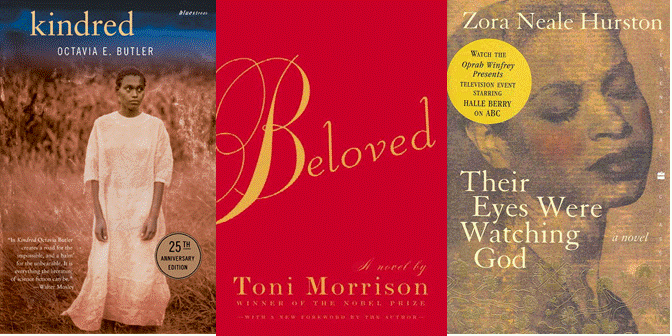
Novel image

1.      Beloved (Toni Morrison)

This Nobel Prize winning novel touches on issues of stereotypes in the media, a mothers’ limitless love, and the dehumanizing aspects of middle passage and slavery. A desperate mother slays her daughter in an attempt to escape her slave master; however, the daughter never dies. Her ghost rises and takes on human form to haunt the town. Trust me: “This is not a story to pass on.

2.      Parable of a Sower (Octavia Butler)

Parable of a Sower throws you into a futuristic dystopian U.S., where companies, in addition to people are slave masters. Protagonist Lauren, must find a safe haven after her family was murdered and her neighborhood was burned by “Paints,” the drug addicts who take pleasure in setting fires watching everyone and everything burn. Lauren is hyperempathic, meaning she can feel others pleasure and pain. In a time where there is mostly pain, Lauren must dodge the Paints, slave masters, and thieves on the road, while trying to overcome her hyperempathy.

3.      Kindred (Octavia Butler)

If you’re interested in time travel, this is your book. Dana involuntarily travels back to the antebellum South, to meet her slave master great great grandfather, and slave great great grandmother. She must ensure that her great great grandpa slave owner lives long enough to father the next generation of her family. Periodically throughout the week Dana is summoned from Los Angeles in 1976 to early 19th century Maryland. During these trips, she must endure the dangers of being a slave and a woman—and there are many.

4.      The Farming of Bones (Edwidge Danticat)

Danticat’s fictional account of The Parsley Massacre of 1937 will fill anyone’s craving for Haitian history. The story follows the main character’s attempt to travel from the Dominican Republic to Haiti to escape the troops of President Trujillo, who have been ordered to slaughter all Haitians in the DR. When she makes it to Haiti, she must come to terms with all emotional pain, the violence, and all the people she lost.

5.      A Small Place (Jamaica Kincaid)

This is actually a nonfiction essay turned into a book, where Kincaid discusses history and life in Antigua. She allows the reader to take the seat of a vacationer as she takes you on a tour while describing the effects of British imperialism on the island.

6.      Song of Solomon (Toni Morrison)

Milkman, given that name for reasons you’ll later discover, goes on a journey to find gold that his father once discovered in a cave next to a dead man. On his trip, Milkman discovers that he is a descendant of flying African slaves, one of whom supposedly flew back to Africa. “If you surrender to the air, you can ride it.”

7.      The Bluest Eye (Toni Morrison…Can you tell she’s my favorite?)

The Bluest Eye is the story of how a little Black girl goes insane by feeding into what Toni Morrison calls “The Mettanarrative,” which is the white man’s view of the world. It’s not a novel with a happy ending, but it’s one that causes us to question our society’s standards of beauty and it claims the lives of many young girls.

8.      All God’s Children Need Traveling Shoes (Maya Angelou)

This awesome autobiography of Maya Angelou tells her journey to Ghana, where she learns much about Ghanaian culture, dates Ghanaian royalty, and walks along the many places where people were stolen or sold into slavery, just before they boarded the slave ships.

9.      Their Eyes Were Watching God (Zora Neal Hurston)

Through three marriages, Janie Crawford, discovers herself and her desire to live independently and find love. It is a tale of a southern Black woman’s journey through poverty and life trials to confidence, independence, and self-love.

10.   I Know Why the Caged Bird Sings (Maya Angelou)

I have to confess that I haven’t read this one yet (Yes, I am very ashamed to say so). The reason being is that I know it is an emotional read.

A few of these novels are actually very emotional reads. That’s why they’re on my Black History list. People of African descent have a heartrending yet enriching past. A few of these novels may bring you to tears. They do what good novels are supposed to do: inform, entertain, uplift, and make us better people. These are the writers that inspire us to tell our own stories, recollect our past histories. They add to the many stories that make Black History Month what it is, a time to remember our past, and be inspired by it.