9 Totally Appropriate Responses to “You Don’t Act/Sound Black”

13 Dec

It happened again, people—this time at work:

My coworker said, “You’re not a real black person, right Shae?”
In my head, I was thinking:

OH NO NO NOSince I’ve been put on the stand to prove my “blackness” countless times, you’d think I’d be quick to tongue-lash anyone who went there with me. But since I was the newest and only black employee, I didn’t want to ruffle any feathers just yet by giving the guy a history lesson. Yet it bothered me that I didn’t respond. This kind of scenario happens to a lot of us. So I created a handy list of responses so that we’re not caught off guard next time it happens.

(I say it’s an appropriate list—but appropriateness is relative. You be the judge)

1. Apologize and ask them for lessons on how to be “more black.”

2. Take off your socks and shoes and pick imaginary cotton while humming a Negro Spiritual… then ask, “Is this what you prefer?”

3. Smack them dead in the face and say, “Oops, my inner-Basketball Wives just came out.”

4. Tell them: “No, I’m not the black person you were expecting. I’m more of the Barack Obama, Toni Morrison, Melissa Harris-Perry, Martin Luther King Jr., Janelle Monáe, bell hooks, Ethel Hedgeman Lyle, Nat Turner, Michelle Obama, Dr. Boyce Watkins, Malcom X, Langston Hughes, Nelson Mandela, Mae Jemison, Henry Louis Gates Jr., Olivia Pope type black person” (But you gotta drop at least 10 names or it doesn’t work).

5. Recount the story of how years ago when your great great great great so and so was a slave, the master beat them so badly, he beat the black out of him. And ever since then, all of his grandchildren and their grandchildren and their grandchildren were born whitewashed.

6. Tell them you had brain surgery so that you could speak as well as all the white folk.

7. Explain that you’re actually just wearing a costume and you’re not an actual black person. You just wanted to jump on the cultural appropriation trend and see what it’s like to be a minority for a day. Then invite them on your next venture to South Africa next for a dose of poverty tourism.

8. Proceed to put your hands on the floor *face down ass up* and have your very best twerking session—and then demand that they give you the best Polka dance lesson ever— and if they can’t—tell them they’re not are a real white person (if not white, demand they do something insultingly stereotypical that person’s culture).

9. Look at them like they’re the stupidest person in the world and tell them you don’t know what they’re talking about… Or you could use the words of our friend Antoine Dodson:

LAST TIME GIFI found a cool video of a poet who encountered the same issue when some girl told him, “Not to sound racist but—you don’t sound black.” Check out his response:

Related Posts:
Am I Black Enough?
Wanting to be a Big Booty Hoe
Yes You Can: Twerk and Have a Brain

P.S. This article is part of the Top Posts. Check out the Best of A Womyn’s Worth.
This Week’s Most Offensive Internet Meme

6 Dec

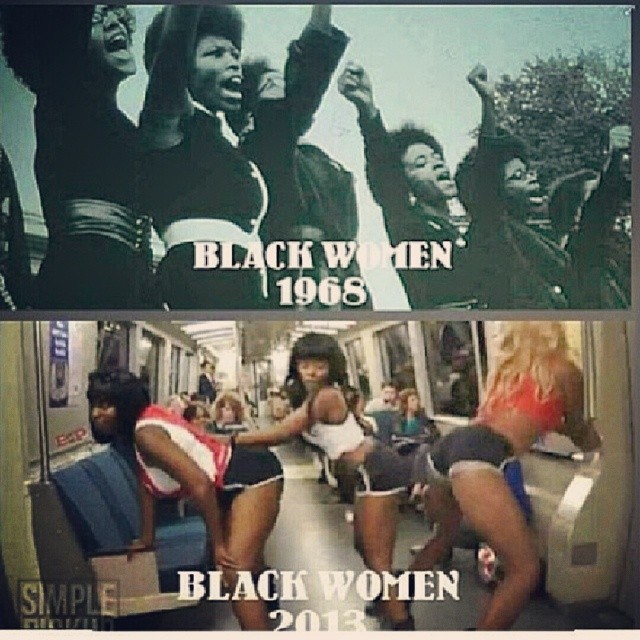
While mindlessly procrastinating on Facebook the other day, I found this repulsive image:

Image

For me, it was a huge slap in face. Yet the meme trended on Instagram and Facebook and had over 3,000 shares.

People praised its “truthfulness” and talked about how young Black women need to take a lesson from women of the past. While I don’t disagree that we should know our history, the execution of this message was poor. The meme makes four ridiculously flawed assumptions about today’s Black women.

Assumption #1: Twerking is the evilest thing in the world*

The discussion on twerking is an interesting one and I’m on the fence. But for now I’ll say this: there’s nothing inherently wrong with twerking. It’s a dance that requires skill and technique.

Yes, it’s sexual—so is tango, which has origins related to prostitution. So was the Can-can when it first came out. Even the belly dance and African dance classes I took as a child can be viewed as sexual when taken out of context.  In the past, these dances were frowned upon because they originated from marginalized groups. The views of dances like tango and twerking are often directly related to the privileged classes’ views of the working class and/or ethnic groups.

Also, we should watch the way we police women’s creative expression—it’s not a crime to be sexual.

On the other hand, the train may not have been the best place to initiate a twerking session—though it wasn’t harming anyone on the train (except maybe the other black women who were worried about being lumped into one massive stereotype, which happens whether people twerk on trains or not).

Assumption #2:  Black women are the same

I think it’s safe to assume that not all Black women twerk on trains. I know I’m not that bold. Not all Black women even know how to twerk (sorry to burst your bubble).

Yet, the way Black women are portrayed in media is the way people, including other Black people, view us as a whole. And the fact that this meme got praise from tons of Black folks shows the media’s negative effect on our own views of our culture.

Quit buying into the nonsense that all black women act a certain way and start looking into media that celebrates the successful ventures of Black women today. Try Clutch Magazine to begin with. They have a whole section called “She’s So Ambitious,” which highlights successes of Black woman entrepreneurs.

Assumption #3: Black women are no longer fighting for equality

There’s a reason you haven’t heard much about the ambitious Black women of 2013. Women like Mikki Kendall, Moya Bailey, Tatyana Fazlalizadeh, Corvida Raven, Leana Cabral, Melissa Harris-Perry, and Sil Lai Abrams, aren’t trending on reality TV, Vine, Worldstar, and Youtube because they don’t fit certain stereotypes. Kanye isn’t going to feature those women in his music videos and Tyler Perry will write them in his script as heartless bitches simply because they are powerful.

The meme completely invalidates the work of the many women I mentioned above, and all the others who like them. Most of those women are fighting for the similar cause of equality that the women in the 1960’s did.

Assumption 4: Black women are one-dimensional

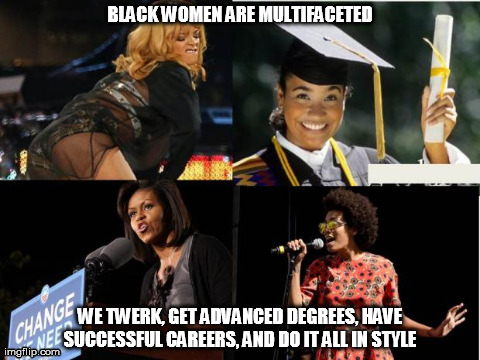
As I discussed in a recent post, women can twerk, get advanced degrees, and have successful careers all at the same time. We are more complex than the Ratchet Hoe vs. Educated Sister dichotomy people seem to have engrained in their minds.

I love the philosophy  of one of my cousins and her friends, who refer  to themselves as “Sophistiratch” because they have a lot of fun and do things that people may deem “ratchet,” while at the same time, they all have degrees and are pursuing careers.

All in all, viewing this meme’s portrayal of Black women as authentic makes you no better than Lily Allen—who views us as twerking objects to be smacked on the butt, mocked for our bodies, and then shamed for our behavior (yet, never applauded for our accomplishments).

When I tried to find memes for this post, I couldn’t find any “Educated Black Woman” or “Successful Black Woman” memes. Of course, “Ghetto Black Girl” and “Stereotypical Black Girl” were readily available. So here’s one I created:

 MULTIF FINAL

Feel free to share it. In the future I hope there are more positive memes for Black women and that these horrific ones cease to spread.

What do you all think of the 2 memes?

Meme photos courtesy of Advance Path, Sarah L. Wilson, and Johnathan Hartford via Flickr. 

*Yes, my views on twerking have changed since I’ve done more research on respectability politics as it relates to race. While I stand by my argument in Sorority Girls must Twerk, people shouldn’t assume that women twerk because of the oppressive demands of us to embody sexual objects. People twerk because they are having a good time or celebrating, among other reasons.

P.S. This article is part of the Top Posts. Check out the Best of A Womyn’s Worth

Come Correct! The Right Way to Approach a Woman

25 Nov

HOW TO APPROACH A WOMAN

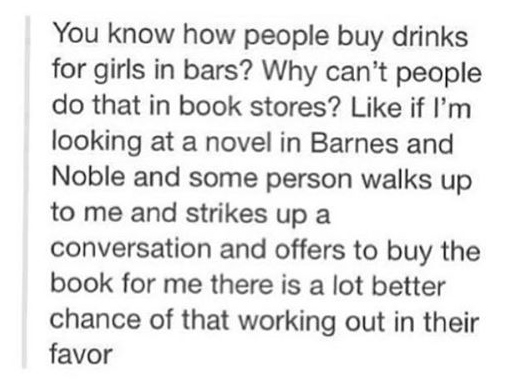
Yesterday I found this on the internet:

Image

And it made me start to think about the way we approach people when we want to ask them out.

Some men go straight for the rude approach and catcall. And for those street harassers, two awesome artists,  Photographer Hannah Price and street artist/illustrator Tatyana Fazlalizadeh, found a new way to call out their catcallers. Whenever someone catcalled at Price, she turned her camera on the guy and snapped his photo, which she published in a project called “City of Brotherly Love.”  Fazlalizadeh illustrated several posters to put up around cities with messages that read, “Women are not outside for your entertainment” and “Stop telling women to smile,” among other things.

In previous posts, I’ve talked about the wrong ways to approach women and my horrific encounters with guys who felt entitled to touch my body as if it were public property. Yet, I’ve never talked about the correct way to approach a woman. And with all the stories I’ve heard from friends who tell me about awful experiences they’ve had with guys who violated their personal space, clearly, some people need to learn.

I recently met a guy who had been taught how to respectfully (and smoothly) approach a woman. Male readers, take note:

I was sitting on a bench on campus reading a boring book for class when this guy walks by and asks what I’m reading. (LESSON 1- Comment on something other than my body).

He sits down on another bench nearby (LESSON 2- Respect personal space). We chat briefly about the book and then talk about our majors. (LESSON 3- Have a nice and brief conversation). After about 4 minutes, he asked for my number. And when I told him no, he responded, “Well I hope you have a nice day and that your book gets better,” and then he was on his way (LESSON 4- Walk away respectfully).

As he left, I felt the need to give him a round of applause. Sadly, no strange man had been that respectful to me in a long time. I so appreciated his approach: simple and respectful. But it’s pretty sad that I felt the need to thank him. It’s sad that I have to tell strangers not to touch my body or that I don’t appreciate the way they talk to me. But because it’s such an issue, I’m going to make a point to thank the guys that approach me respectfully. Hopefully, that encourages them and others to continue to do so.

And since I didn’t get a chance to thank that guy:

Dear Dwaine,

Thank you for treating me like a human being.

Related Posts: “Aye Sexy” is NOT How I Like to be Approached

There Won’t be a Second Date If…

You Can Find Me in Da Club—but Don’t Touch Me!