Tag Archives: feminism

This Week’s Most Offensive Internet Meme

6 Dec

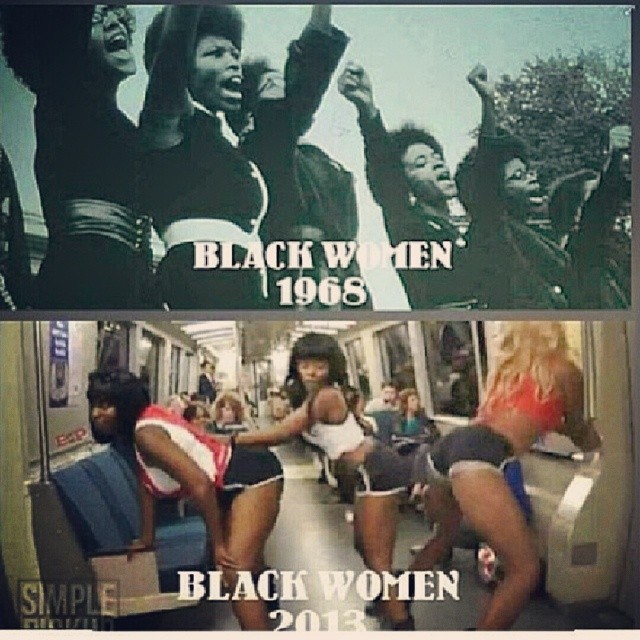
While mindlessly procrastinating on Facebook the other day, I found this repulsive image:
Image

For me, it was a huge slap in face. Yet the meme trended on Instagram and Facebook and had over 3,000 shares.

People praised its “truthfulness” and talked about how young Black women need to take a lesson from women of the past. While I don’t disagree that we should know our history, the execution of this message was poor. The meme makes four ridiculously flawed assumptions about today’s Black women.

Assumption #1: Twerking is the evilest thing in the world*

The discussion on twerking is an interesting one and I’m on the fence. But for now I’ll say this: there’s nothing inherently wrong with twerking. It’s a dance that requires skill and technique.

Yes, it’s sexual—so is tango, which has origins related to prostitution. So was the Can-can when it first came out. Even the belly dance and African dance classes I took as a child can be viewed as sexual when taken out of context.  In the past, these dances were frowned upon because they originated from marginalized groups. The views of dances like tango and twerking are often directly related to the privileged classes’ views of the working class and/or ethnic groups.

Also, we should watch the way we police women’s creative expression—it’s not a crime to be sexual.

On the other hand, the train may not have been the best place to initiate a twerking session—though it wasn’t harming anyone on the train (except maybe the other black women who were worried about being lumped into one massive stereotype, which happens whether people twerk on trains or not).

Assumption #2:  Black women are the same

I think it’s safe to assume that not all Black women twerk on trains. I know I’m not that bold. Not all Black women even know how to twerk (sorry to burst your bubble).

Yet, the way Black women are portrayed in media is the way people, including other Black people, view us as a whole. And the fact that this meme got praise from tons of Black folks shows the media’s negative effect on our own views of our culture.

Quit buying into the nonsense that all black women act a certain way and start looking into media that celebrates the successful ventures of Black women today. Try Clutch Magazine to begin with. They have a whole section called “She’s So Ambitious,” which highlights successes of Black woman entrepreneurs.

Assumption #3: Black women are no longer fighting for equality

There’s a reason you haven’t heard much about the ambitious Black women of 2013. Women like Mikki Kendall, Moya Bailey, Tatyana Fazlalizadeh, Corvida Raven, Leana Cabral, Melissa Harris-Perry, and Sil Lai Abrams, aren’t trending on reality TV, Vine, Worldstar, and Youtube because they don’t fit certain stereotypes. Kanye isn’t going to feature those women in his music videos and Tyler Perry will write them in his script as heartless bitches simply because they are powerful.

The meme completely invalidates the work of the many women I mentioned above, and all the others who like them. Most of those women are fighting for the similar cause of equality that the women in the 1960’s did.

Assumption 4: Black women are one-dimensional

As I discussed in a recent post, women can twerk, get advanced degrees, and have successful careers all at the same time. We are more complex than the Ratchet Hoe vs. Educated Sister dichotomy people seem to have engrained in their minds.

I love the philosophy  of one of my cousins and her friends, who refer  to themselves as “Sophistiratch” because they have a lot of fun and do things that people may deem “ratchet,” while at the same time, they all have degrees and are pursuing careers.

All in all, viewing this meme’s portrayal of Black women as authentic makes you no better than Lily Allen—who views us as twerking objects to be smacked on the butt, mocked for our bodies, and then shamed for our behavior (yet, never applauded for our accomplishments).

When I tried to find memes for this post, I couldn’t find any “Educated Black Woman” or “Successful Black Woman” memes. Of course, “Ghetto Black Girl” and “Stereotypical Black Girl” were readily available. So here’s one I created:
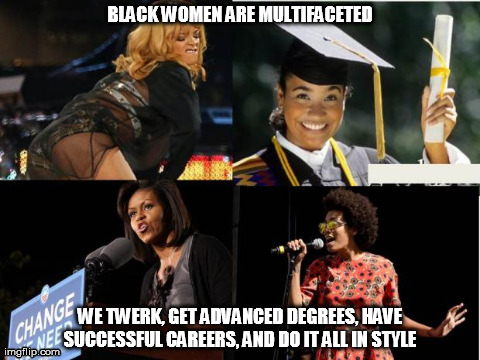
 MULTIF FINAL

Feel free to share it. In the future I hope there are more positive memes for Black women and that these horrific ones cease to spread.

What do you all think of the 2 memes?

Meme photos courtesy of Advance Path, Sarah L. Wilson, and Johnathan Hartford via Flickr. 

*Yes, my views on twerking have changed since I’ve done more research on respectability politics as it relates to race. While I stand by my argument in Sorority Girls must Twerk, people shouldn’t assume that women twerk because of the oppressive demands of us to embody sexual objects. People twerk because they are having a good time or celebrating, among other reasons.

P.S. This article is part of the Top Posts. Check out the Best of A Womyn’s Worth

YES YOU CAN: Twerk and Have a Brain

15 Nov

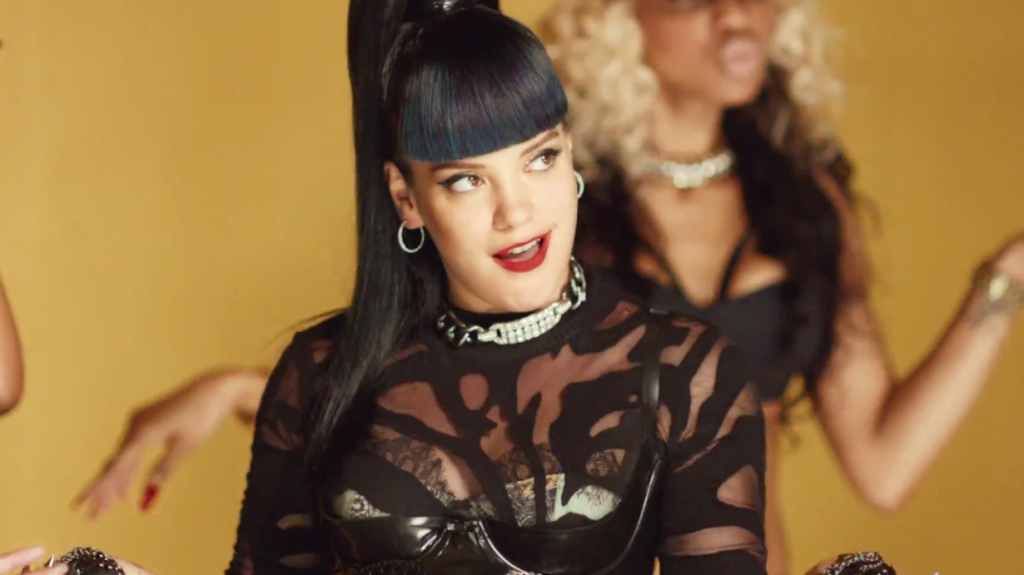
LILY ALLEN2“It’s hard out here for a bitch,” says British so-called feminist singer Lily Allen in her latest song, “It’s Hard Out Here.” The video is satirical and supposed to critique the music industry’s expectations of women. Yet in the process, Allen upholds oppressive views of black sexuality.

Allen sings, “Inequality promises that it’s here to stay.”

Yes it does, Lily Allen, because you’re promoting it.

So welcome to this week’s episode of “How Not to be a Feminist,” starring Lily Allen.

She sings about how women in the industry are objectified—and then she turns right around and objectifies the backup dancers, who are mostly black women.

The message is clear: It’s not okay to objectify women, unless they’re women of color.

In the video, Allen is fully clothed doing a few dance moves here and there (but mostly just standing around), surrounded by half-naked black women twerking as if their lives depended on it. Allen stands out from the dancing women in her clothes and minimal dance moves as if she I somehow better than them. These scenes all happen right after she says, “Don’t need to shake my ass for you cause I’ve got a brain.”

Allen would like us all to know that she has a brain—and the women shaking their asses for her video…well… I guess they don’t get to decide if they’re intelligent or not because Lily Allen did it for them.

When did shaking your ass become synonymous with being unintelligent? There are plenty of smart women who dance provocatively when they want to and then study their asses off or go to their meaningful careers the next day.

One person tweeted in response, “I shake my ass in front of my degree every morning. Then I shake my ass at my desk at work–senior front-end developer, thanks.”

When I find myself at a party, club, or in front of a mirror when no one’s looking, I’ll shake my ass too. Hey Lily, look…I have a brain too.

The video is a classic case of satire gone very wrong. Instead of correcting the industry, Allen added herself to the list of white woman artists that dehumanize black women. It was as if Miley Cyrus (swear I won’t use her name any more) dressed up as a feminist for Halloween—but underneath the costume is the same ignorance and oppression.

If anything, Allen’s video proved one thing—it’s harder out here for some women than others (something women of color have proved time and time again). Allen and her white singer counterparts aren’t demonized for their sexuality in the same way black women are. It’s assumed that Lily is a person, while the dancers aren’t even considered to be fully human. As Mia McKenzie from Black Girl Dangerous explains it, the video cuts away at the bodies of black women as if they are parts and pieces, instead of full human beings. The video lifts up women of a certain complexion while oppresses those of another. That’s the same kind of privileged fake feminism I talked about in last week’s post.

Lesson learned: Check you’re feminism, or others surely will.

Welp, guess it’s back to listening to Janelle Monae.

Related Posts: Feminism Gets a Bad Facelift

Top Women Rappers You NEED on Your Playlist

Feminism Gets a Bad Facelift

6 Nov

Feminism Goes Under the Knife

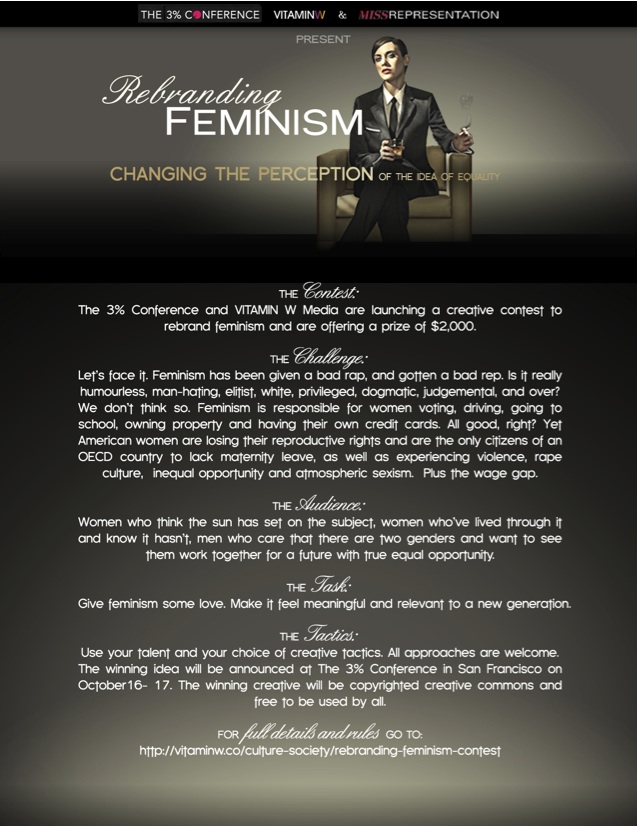
Rebrand1For a while now, various individuals, media outlets, and organizations have called for the rebranding of feminism, claiming that the movement’s bad rep (you know: man-hating, no-shaving, bra-burning lesbians) must be fixed. Last month, Women’s media platform Vitamin W made a big “oopsie” when launching what they call the “Rebranding Feminism” contest.

Originally, the contest looked like another bad facelift on a type of feminism that is no stranger to the back-alley plastic surgeon—a type of feminism whose privileged members seek to revamp the movement, yet, blindly fail to address the experiences of women of color, the LGBT community, low-income workers, and full-time mothers. Yes, maybe this type of feminism should seek an upgrade.

Vitamin W’s mistake was their approach: Their original signage, presenting a white woman in business attire drinking Scotch, called for people to create an image, video, or poster to represent the new face of feminism.

Fem Makeover

(click for larger image)

Ironically, the contest displayed the very reasons many educated women who fight for gender equality do not identify as feminists. The woman’s image and some of the wording on the signage (the wording offended many people who do not identify as male or female) displayed the historically exclusionary practices of the feminist movement .

Fortunately, there was immediate outrage on the internet and Vitamin W listened. They changed their signage, and have recently announced their contest winner, who was smart enough not to use an image that would be viewed as discriminatory. However, neither the change in Vitamin W’s signage nor the winning poster touches the heart of the issue.

Rebranding enthusiasts tend to focus on changing the face of feminism so that it’s prettier and more inviting to the masses. Yet, we don’t need a commercialized version of feminism because feminism isn’t always pretty—it isn’t 24-7 Kumbaya. Sometimes it’s about checking your privilege, admitting the ways you have wrongly (sometimes unknowingly) oppressed others, and shutting up so you can listen to people with experiences different from your own. Otherwise, the movement becomes as weak as 2 Chainz’ lyrics, with uninformed feminists who talk a good game about solidarity, but are grossly bigoted. A cutesy version of feminism would water down the multifaceted aspects of the movement and its potential to address not only gender issues, but also intersecting issues of race, class, sexuality, ability, and everything in between.

Instead of preparing feminism for facial reconstruction to appeal to audiences who shy away from the F word, rebranding enthusiasts should switch their focus. As a participant in on Bitch Media’s rebranding feminism online discussion panel suggested, those seeking to upgrade feminism should address the needs of women who already identify as feminists or believers in gender quality, but feel left out of the movement. Just ask the women who participated in #solidarityisforwhitewomen, a hashtag that fuelled worldwide discussion about how women of color feel their issues are unaddressed by the feminist movement.

Mainstream feminists in the movement need to open their eyes and acknowledge issues of women who aren’t quite as privileged. For example, feminist campaigns to widen access to Plan B, often do not benefit women on Native American reservations, who in many cases, have the least amount of access in the country. White feminists who reclaim the word slut fail to realize that it isn’t quite as easy for Black women to do so. And exactly where was all of the feminist outrage, rallying, and campaigning when reporters announced that California doctors illegally sterilized about 150 women in prison?

Clearly, rebranding without any real effort to acknowledge all equality issues isn’t going to solve the exclusivity problems in the movement. Instead of simply talking about feminism being an all-inclusive fight for equality, we have to truly be about it.

Unfortunately, Vitamin W’s contest won’t be the last we hear about rebranding. Elle U.K. has made it their task for their November issue, and an organization called We are the XX recently created a new “feminist manifesto.”  But frankly, these tired calls to rebrand feminism are futile.

Rebranding isn’t enough. It isn’t enough to make feminism “cool.” Instead, as writer Samhita says in a recent Feministing article, “As much as it is easy to rest on the “equality between the sexes” definition of feminism, if we want to change public perception of feminism, we actually have to change feminism itself. We have to both push for a world that demands gender equality, while pushing for a feminism that acknowledges, accepts, and truly incorporates difference.”