Tag Archives: Black women

How to Change the Image of Women in Hip Hop

19 Mar

How to Change the Image of Women in Hip Hop: from Powerlessness to Activism

Lately I’ve been hearing a collective complaint regarding the image of black women in the media: There’s nothing we can do about it.

In an interview with Clear Channel (a large mass media company), activists from an organization called FAANMAIL explained that people don’t feel empowered enough to change hip hop’s portrayal black women. People don’t feel like they can’t make a difference because of the large entities they are up against.

Yes, the task will be challenging.

When challenging misogyny and racism in the media, you’re up against powerful companies with billions of dollars, that control what airs on TV and the radio, and employ several destructively influential hip hop artists, reality TV stars, and insatiable businessmen that all act as a collective Goliath.

That’s why people don’t try.

But we need to get out of this powerless state of mind. It’s not the government, the industry, or “the system,” that suppresses our voice—it’s the belief that we can’t do it that stagnates progress. Our feelings of powerlessness are partly the reason the image of black women in the media is what it is: an uneducated, hypersexed, “big booty hoe” with no concept of manners or self-respect.

However, change is not impossible. People have already made tremendous strides. Several organizations, such as FAANMAIL and Truth in Reality, work to change the image of black women in the media. In addition, we’ve all heard about how one writer, Sabrina Lamb, started the petition that canceled the show All My Babies Mamas. This is just the first step.

More work must be done—and it cannot solely happen online. It’s great to raise awareness through petitions on Change.org and social media, but armchair activism cannot replace live effort.

Activism online is too easy, and as the Harvard Crimson puts it, “Effective activism that creates lasting change takes effort and is often very frustrating. In fact, if an action is shiny, prepackaged, easy, and does not require any research or other sort of effort on the doer’s part, that is probably a sign that it is not going to be highly effective. If we hope to make a difference, it is essential that we are critical of such representations.”

In other words, real activism requires you to leave your computer screen and get your ass off of the couch (Ironically, I need to take my own advice. Blogging is a start; but, it’s not enough).

Here are some ideas on how to get active:

  • Connect with like-minded individuals.
  • Partner with organizations that are already doing the work
  • Host public rallies to show others there is a group that cares about the issue.
  • Use social media to its fullest extent
  • Involve local newspapers to spread the word
  • Get corporate sponsors (I know this may be easier said than done…yet still possible)
  • Try focusing on what changes you would like to see in the media (explaining what you don’t like is good, but giving examples of what you would like shows potential)

Of course, all of this will not happen overnight. But its the perseverance, dedication, and passion that gets things done.

“No work is insignificant. All labor that uplifts humanity has dignity and importance and should be undertaken with painstaking excellence.”

~Dr. Martin Luther King Jr.

Recommended Link: http://faanmail.wordpress.com/2013/03/12/talk-back-our-conversation-with-clear-channel-about-community-concerns/

Am I Black Enough?

12 Mar

I didn’t listen to Tupac growing up, I’ve never seen any of the Friday movies, and I can’t twerk.

Only a priest at Confession could get me to admit all of that. I was ashamed to say so in fear that my “Authentic Black Girl Card” would be revoked.

The other day I picked up Patricia Collins’ Black Sexual Politics.* She explains how mass media “blurs the lines between fact and fiction” on the image of Black people, and because of that, some representations of Black people have become commonsense “truths,” when really they are all stereotypes created by sources outside of our communities.

Sadly, we adopt these stereotypes and hold one another to them. We are expected to “act Black,” and we ostracize those who do not.

At young ages, Black children who are raised in Black communities learn what it means to be “authentically” Black. I picked up on in the 3rd grade. By that time, I’d learned to speak a certain way, pronouncing or not pronouncing certain syllables.

I often felt the need to hide my social class –so I avoided telling people that I was from Ladera Heights (a wealthy Black neighborhood in LA) because in elementary school, being from Inglewood was more acceptable.

In middle school I learned to dance how Black girls are expected to dance: bent over in front of a guy, moving my ass on his crotch to the beat. I was never good at it. But imagine my joy when I realized I could Crip-walk. I thought to myself, “Yes! Evidence that proves I’m really Black!

But despite all my attempts, I was still labeled whitewashed—and I still am (you know it’s bad when your Korean friends say it).

The “problem” is: I don’t fit the stereotype of what the media says a Black woman should be. The societal definition of what it means to be Black (which is dangerously similar to the racist19th Century beliefs of colonial powers) is how some of us define ourselves.

And those definitions are damaging. For example, Collins tells us, “Black men in pursuit of booty calls may appear to be more authentically ‘Black’ than men who study, and the experiences of poor and working class Black men may be established as being more authentically Black than those of the middle-and upper-middle class African American men” (Collins 151).

So I’m not going to define myself by racist standards of what it means to be Black—because you can’t be genuine if others are still defining who you are.

My Top 10 Novels for Black History Month

12 Feb

(Written by incredible women writers)

Novel image

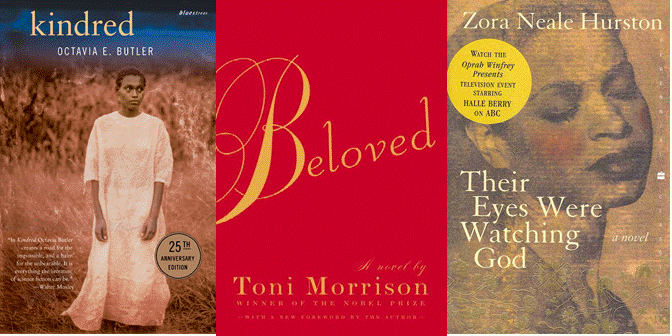
1.      Beloved (Toni Morrison)

This Nobel Prize winning novel touches on issues of stereotypes in the media, a mothers’ limitless love, and the dehumanizing aspects of middle passage and slavery. A desperate mother slays her daughter in an attempt to escape her slave master; however, the daughter never dies. Her ghost rises and takes on human form to haunt the town. Trust me: “This is not a story to pass on.

2.      Parable of a Sower (Octavia Butler)

Parable of a Sower throws you into a futuristic dystopian U.S., where companies, in addition to people are slave masters. Protagonist Lauren, must find a safe haven after her family was murdered and her neighborhood was burned by “Paints,” the drug addicts who take pleasure in setting fires watching everyone and everything burn. Lauren is hyperempathic, meaning she can feel others pleasure and pain. In a time where there is mostly pain, Lauren must dodge the Paints, slave masters, and thieves on the road, while trying to overcome her hyperempathy.

3.      Kindred (Octavia Butler)

If you’re interested in time travel, this is your book. Dana involuntarily travels back to the antebellum South, to meet her slave master great great grandfather, and slave great great grandmother. She must ensure that her great great grandpa slave owner lives long enough to father the next generation of her family. Periodically throughout the week Dana is summoned from Los Angeles in 1976 to early 19th century Maryland. During these trips, she must endure the dangers of being a slave and a woman—and there are many.

4.      The Farming of Bones (Edwidge Danticat)

Danticat’s fictional account of The Parsley Massacre of 1937 will fill anyone’s craving for Haitian history. The story follows the main character’s attempt to travel from the Dominican Republic to Haiti to escape the troops of President Trujillo, who have been ordered to slaughter all Haitians in the DR. When she makes it to Haiti, she must come to terms with all emotional pain, the violence, and all the people she lost.

5.      A Small Place (Jamaica Kincaid)

This is actually a nonfiction essay turned into a book, where Kincaid discusses history and life in Antigua. She allows the reader to take the seat of a vacationer as she takes you on a tour while describing the effects of British imperialism on the island.

6.      Song of Solomon (Toni Morrison)

Milkman, given that name for reasons you’ll later discover, goes on a journey to find gold that his father once discovered in a cave next to a dead man. On his trip, Milkman discovers that he is a descendant of flying African slaves, one of whom supposedly flew back to Africa. “If you surrender to the air, you can ride it.”

7.      The Bluest Eye (Toni Morrison…Can you tell she’s my favorite?)

The Bluest Eye is the story of how a little Black girl goes insane by feeding into what Toni Morrison calls “The Mettanarrative,” which is the white man’s view of the world. It’s not a novel with a happy ending, but it’s one that causes us to question our society’s standards of beauty and it claims the lives of many young girls.

8.      All God’s Children Need Traveling Shoes (Maya Angelou)

This awesome autobiography of Maya Angelou tells her journey to Ghana, where she learns much about Ghanaian culture, dates Ghanaian royalty, and walks along the many places where people were stolen or sold into slavery, just before they boarded the slave ships.

9.      Their Eyes Were Watching God (Zora Neal Hurston)

Through three marriages, Janie Crawford, discovers herself and her desire to live independently and find love. It is a tale of a southern Black woman’s journey through poverty and life trials to confidence, independence, and self-love.

10.   I Know Why the Caged Bird Sings (Maya Angelou)

I have to confess that I haven’t read this one yet (Yes, I am very ashamed to say so). The reason being is that I know it is an emotional read.

A few of these novels are actually very emotional reads. That’s why they’re on my Black History list. People of African descent have a heartrending yet enriching past. A few of these novels may bring you to tears. They do what good novels are supposed to do: inform, entertain, uplift, and make us better people. These are the writers that inspire us to tell our own stories, recollect our past histories. They add to the many stories that make Black History Month what it is, a time to remember our past, and be inspired by it.