3 Things Someone Should Tell Miley Cyrus

18 Jun

miley_cyrus_juicy_j

Miley 2.0, Take A Seat

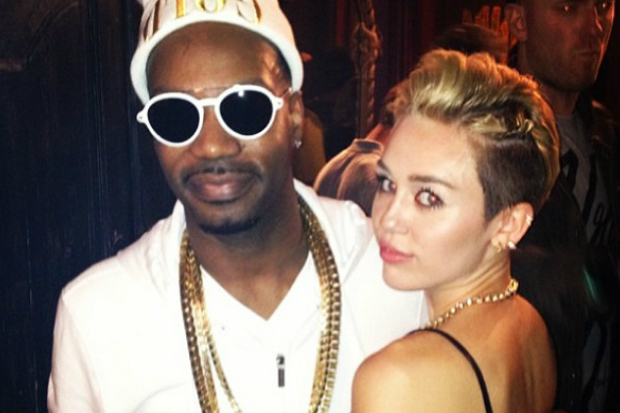
Lately people have been buzzing about how Miley Cyrus twerked on stage at a Juicy J concert and about her latest song produced by Mike Will Made It. At first, I was upset that she received so much attention. I saw news anchors on television discussing her twerking, and I thought, “Why the F is this news?” So I was hesitant to write this post. Yet, with all the comments about Milley 2.0 “trying to act black” and “being ratchet,” I felt the need to say something about her new tactic to increase the hype of her upcoming album.

Unlike many people who are quick to shame Miley Cyrus for her recent twerking obsession and her new sound, which claims that she is “bout that life,” I won’t go there. Let her twerk if she wants to—but don’t you dare applaud her for twerking and then turn around and criticize all the black women who twerk.

I have other issues with little Ms. Party in the USA.

1) Stop referring to hip hop and other music from black artists as “hood” music. In a recent interview with Billboard, she claimed that she loved “hood” music.

I think most of us know (but someone needs to let Miley know) that the majority of commercial hip hop sales are from suburban areas and that about 60% of those consumers are white.* Miley, sweetie, you aren’t special because you like Juicy J—you’re part of the 60%. But hey, maybe some of that 60% who bump fictitious “hood” music, yet haven’t gone beyond their white picket fences may pick up her album. Maybe Miley’s onto something.

2) Tread lightly and remember your privilege. The other day one of my sorors tweeted,

So when I twerk, I’m ratchet. But when Miley twerks she’s queen goddess of all unicorns!?”

She raises a major issue. Commenters on several blog sites said that Miley twerking was “cute” or “adorable.”

First of all… No. It wasn’t. Think about it—would it be adorable if it were Willow Smith or Gabby Douglas? Is it cute when Nicki Minaj twerks? No! Many people have internalized a double standard and would criticize young black women for being overly sexual.
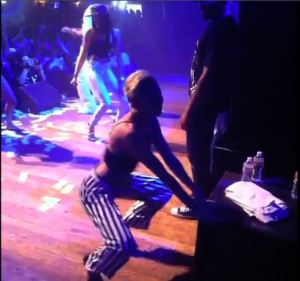
Miley at Juicy J concert

Miley twerking at Juicy J concert

Blogger Necole Betchie wrote that Miley is “definitely carrying around a ‘ratchet’ card somewhere in her back pocket.” Yes, she may be carrying the card, but she can use or toss it as needed. Others don’t have that luxury. According to writer Sesali Bowen, many people (mainly black women) are labeled ratchet because of their poverty, clothing choices, and actions, and they cannot shake the label as easily. So be careful who you call ratchet.

3) Do what you do. Let Miley be Miley. Hanna Montana, Miley 2.0, rebel Disney star, whatever. If you don’t like her, don’t listen to her and don’t talk about her. That being said, I’m not going to say anything else about her. But I think it’s imperative that we think about and discuss double standards, white privilege, and what is acceptable for certain women to do but not others.

If you don’t feel like reading up on cultural appropriation, check out “White Privilege” by rapper Macklemore. His song is open and honest about how white musicians fit into black music.

*Stats from Rhythm and Business: The Political Economy of Black Music

Related Articles:
Sorority Girls Must Twerk: Cultural Demands on Black Women

Let’s Get Ratchet!: Check Your Privilege at the Door

Video

2 AWESOME Videos Everyone Should See

12 Jun

I saw 2 feminist videos this week that I couldn’t get out of my mind I wanted to share.

We Should All Be Feminist by  Chimamanda Ngozi Adichie

Before you rule out the video because of its 30-minute length, (I know, I usually don’t have the time or attention span either) hear me out. Chimamanda Ngozi Adichie tells her journey to feminism in a comically entertaining TED Talk that touches on socialization based on gender, Her speech is captivating and supported with wit and comedy. Although she talks about her experiences in Lagos, Nigeria, many of those same issues cross the Atlantic and also occur in the U.S.

Who Run The World (Girls) by Beyonce. Interpreted in American Sign Language

If you love dancing and have even the slightest interest in American Sign Language (ASL), then you will really enjoy this video. I’m an ASL student and a huge fan of interpreting songs. This video is so fun and the interpreters are fierce. While watching I was like, “get it girls!”  The interpreting felt so natural and was done with so much confidence.

Hope you enjoy them both 🙂 Let me know what you think.

Wanting to be a Big Booty Hoe

29 May

2chainz-birthday-song

The Definition of Sexy

In high school, my nickname was “Feed the Children,” because my friends joked that I was skinny enough to be in Feed the Children’s campaigns about malnourished children in third world countries (Clearly my friends weren’t very PC).

I was somewhat insecure about my thin frame because I had internalized something that I’d learned from listening to hip hop and the guys at school: girls with curves and big booties were sexy—bony little “Feed the Children,” was not.

So I always wanted to be thicker. Three years later, while studying overseas in Argentina, where my diet consisted mostly of pasta and cheese, I gained some weight and grew what became my pride and joy: my ass. Coming home from Buenos Aires with a little curve in what I believed was all the right places gave me a synthetic confidence.

Imagine my disappointment one day when I turned to the side in the mirror only to find that my booty had shrunk, and for a little while, so had my confidence.

As women, many of us are all taught at young ages —either from our parents, magazines, music, or the world around us—that part of our duty is to be pleasing to the eye. Scholars Sheila Lintott and Sherri Irvin explain in “Sex Objects and Sexy Subjects: A Feminist Reclamation of Sexiness,” women are socialized to believe that being sexy is essential to their value as human beings, and that only certain looks are defined as sexy. When someone fails to adhere to those narrow standards of sexy she may be viewed as less of a woman.

That is how I felt when I looked in the mirror and saw my lack of curves: I was less sexy; I was less of a woman.

Many of us have those times where we judge ourselves according to someone else’s definition of sexy. In doing so, we progress this idea that sexy means fitting into a very small box (more like a very small prison).

We are often taught that we are too skinny, too big, or too dark. We have too much of this and not enough of that. Most women do not fit the dominant idea of sexy.

However, many people go to great lengths to try to fit into that prison. We spend hundreds of dollars on our hair and makeup, constantly change our diets, wear the highest, most uncomfortable heels, experience a lot of pain (sometimes at the hands of beauticians, stylists, or plastic surgeons), and in the process, we deny and reject our real selves.

There’s a difference between the synthetic confidence I attained when I first noticed my weight gain and the real confidence I got from defining sexy on my own terms. Sometimes I have to remember that sexy isn’t something I can buy in a bottle at Sephora for $45. Nor is it my favorite pair of heels that make my legs look longer. Sexy is a fusion of confidence and compassion. It is a decision to live on my own terms (not according to anyone else’s expectations). Sexy is a lifestyle.