Archive | Self Empowerment RSS feed for this section

Wanting to be a Big Booty Hoe

29 May

2chainz-birthday-song

The Definition of Sexy

In high school, my nickname was “Feed the Children,” because my friends joked that I was skinny enough to be in Feed the Children’s campaigns about malnourished children in third world countries (Clearly my friends weren’t very PC).

I was somewhat insecure about my thin frame because I had internalized something that I’d learned from listening to hip hop and the guys at school: girls with curves and big booties were sexy—bony little “Feed the Children,” was not.

So I always wanted to be thicker. Three years later, while studying overseas in Argentina, where my diet consisted mostly of pasta and cheese, I gained some weight and grew what became my pride and joy: my ass. Coming home from Buenos Aires with a little curve in what I believed was all the right places gave me a synthetic confidence.

Imagine my disappointment one day when I turned to the side in the mirror only to find that my booty had shrunk, and for a little while, so had my confidence.

As women, many of us are all taught at young ages —either from our parents, magazines, music, or the world around us—that part of our duty is to be pleasing to the eye. Scholars Sheila Lintott and Sherri Irvin explain in “Sex Objects and Sexy Subjects: A Feminist Reclamation of Sexiness,” women are socialized to believe that being sexy is essential to their value as human beings, and that only certain looks are defined as sexy. When someone fails to adhere to those narrow standards of sexy she may be viewed as less of a woman.

That is how I felt when I looked in the mirror and saw my lack of curves: I was less sexy; I was less of a woman.

Many of us have those times where we judge ourselves according to someone else’s definition of sexy. In doing so, we progress this idea that sexy means fitting into a very small box (more like a very small prison).

We are often taught that we are too skinny, too big, or too dark. We have too much of this and not enough of that. Most women do not fit the dominant idea of sexy.

However, many people go to great lengths to try to fit into that prison. We spend hundreds of dollars on our hair and makeup, constantly change our diets, wear the highest, most uncomfortable heels, experience a lot of pain (sometimes at the hands of beauticians, stylists, or plastic surgeons), and in the process, we deny and reject our real selves.

There’s a difference between the synthetic confidence I attained when I first noticed my weight gain and the real confidence I got from defining sexy on my own terms. Sometimes I have to remember that sexy isn’t something I can buy in a bottle at Sephora for $45. Nor is it my favorite pair of heels that make my legs look longer. Sexy is a fusion of confidence and compassion. It is a decision to live on my own terms (not according to anyone else’s expectations). Sexy is a lifestyle.

Sorority Girls Must Twerk

16 May

Image

Originally published on Racialicious.

“So you’re going to twerk right?” was a common question my sorority sisters and I got when we entered a dance competition this year at our school.

Not too long ago, the university I attend welcomed its first historically black Greek-letter organization. I had the privilege of becoming a member of this sorority and was curious to see how the students of a predominately white university in a wealthy area would receive a historically black organization on its campus.

The university was widely accepting of the sorority; however, as we became more visible on the campus, we experienced much cultural insensitivity.

This year, for the first time, we participated in a sorority dance competition that raises money for charity. During the week leading up to the dance-off, several people approached us asking if we were going to twerk — as if twerking is the only style of dance a black woman can do.

Yes, most of the pleas for us to twerk on stage were jokes—you know, those obnoxious, not so funny, purposefully racist jokes—the same jokes many people shrug off and laugh along with because they are believed to be harmless.

Yet, there is a serious problem when we idly allow people to make ignorant and unacceptable comments, especially those that trivialize issues of class and race. As we read in the article, “Let’s Get Ratchet! Leave Your Privilege at the Door,” also featured on Racialicious, views about twerking employ certain bigoted ideas about poverty and black culture.

These comments and jokes about our sorority twerking relate to the effects of a black woman’s image based on media coverage. With the countless Twerk Team videos on Youtube and the glorifying of a “bad bitch” who can “bend it over and touch her toes” in commercial hip hop lyrics,this style of dance has become a fabricated indicator of “authentic” black womanhood. Essentially, the conversation about the style of dance becomes: all “real” black women can twerk.

This expectation is progressed through the numerous videos of young black women popularizing the dance style online (They aren’t the only ones doing it, but they are a significant majority). On one hand, if a woman chooses to dance sexually that is her choice. However, I find it problematic if her decision to twerk comes from commercial hip hop’s ideas about women (none of which are uplifting) and the songs that accompany the dance, such as French Montana’s “Pop That” and Juicy J’s “Bandz A Make Her Dance,” which demand a woman’s complete submission in order to sexually please her male company. Type “twerk” into youtube and you’ll find several young women accepting the sex-object role that the music demands of them. These demands become increasingly problematic when they involve race and gender. Notice that no expectations are placed on men or women of other ethnicities to twerk. People are often shocked when white women do it.

As it is extremely provocative, twerking suggests a lot about black sexuality. As feminist theorist Patricia Hill Collins discusses in Black Sexual Politics, African Americans’ use of their bodies is heavily promoted and celebrated above other abilities, such as intellect.

Maybe that is why there aren’t many stereotypes about black women being smart.

The focus on black bodies is not a new concept. Author Norman Kelly explains in Rhythm and Business that these ideas date back to slavery, when bodies were used to cut sugarcane and harvest tobacco, and raped to produce more bodies for labor. Yet, too much use of the mind was prohibited, as reading was illegal.

This use of bodies, specifically, the focus on what twerking accentuates, a woman’s behind, dates even further back to the 19th century, when Saartjie Baartman first made her appearance in Europe as the freak show Venus Hottentot. People visited the show to gawk and mock her huge behind and peek under her clothing to look at her vagina.

These 19th century views continue to exist in the comments about twerking. When people expect or demand that we twerk, black women are once again reduced to a piece of ass.

Unfortunately, many people of color have adopted some of these external views on black sexuality, as several of the jokes about our sorority twerking came from other African American students on campus. During the preparation for another show, one black student who saw us practicing also asked if we would twerk for our half-time basketball game performance. In asking this, he and other students of color who made similar comments participate in progressing harmful stereotypes of black women. Because this guy’s mind went right to twerking when he heard we were dancing, his views of women how black women should appear on stage have been influenced by disgusting stereotypes of black women in popular culture.

As leaders and promoters of equality, we must amend the incorrectly-deemed “harmless” jokes and comments about black sexuality, as they further the idea that black people are only good for physical activities such as manual labor, dancing, and sex. These jokes suppress ideas about successful black scholars and intellectual leaders.

When these dehumanizing ideas circulate in popular culture, I am concerned about how they affect our self-narratives and self-esteem. Growing up, my friends and I wrestled with what it meant to be authentically black. Our music interest, sense of fashion, and ways of dancing were all influenced by external ideas about black culture that we saw in music videos, on the radio, and from our peers (this was just before Youtube and Twerk Team became popular). As much of my teenaged perception about what “authentic” blackness meant came from BET, where currently Nicki Minaj acts as an updated Venus Hottentot (as much of her brand, appearance, clothing and lyrics point to the same two body parts Europeans gawked over at Baartman’s freak show: her ass and vagina). I eventually had to unlearn a lot of the demeaning ideas of black womanhood I was exposed to. I am still in the process of unlearning.

Calling people out on their rude jokes and comments aids this unlearning process and teaches them about the stereotypes they uphold when they make such comments.

Authors note: Hello All, I wrote this article when I was new to feminism and hadn’t realized the harm of respectability politics. My views have changed. Check out the articles below, which are more up-to-date on my Black feminist politics.

“Aye Sexy” is NOT How I Like to be Approached

7 May

Slide1

I’ve wanted to write a post on how to reject a guy who disrespectfully approaches women with ignorant comments like, “Damn sexy!,” “Aye shawty,” and “Where yo boyfriend at?” like the guy from the Mad TV sketch, “Can I Have Yo Number?” I wrote that post several months ago but never published it because I felt like it was missing something.

After recently watching the video “Take Back the Night – Catcalling” by students at USC, I realized the seriousness of all those rude comments catcallers say.

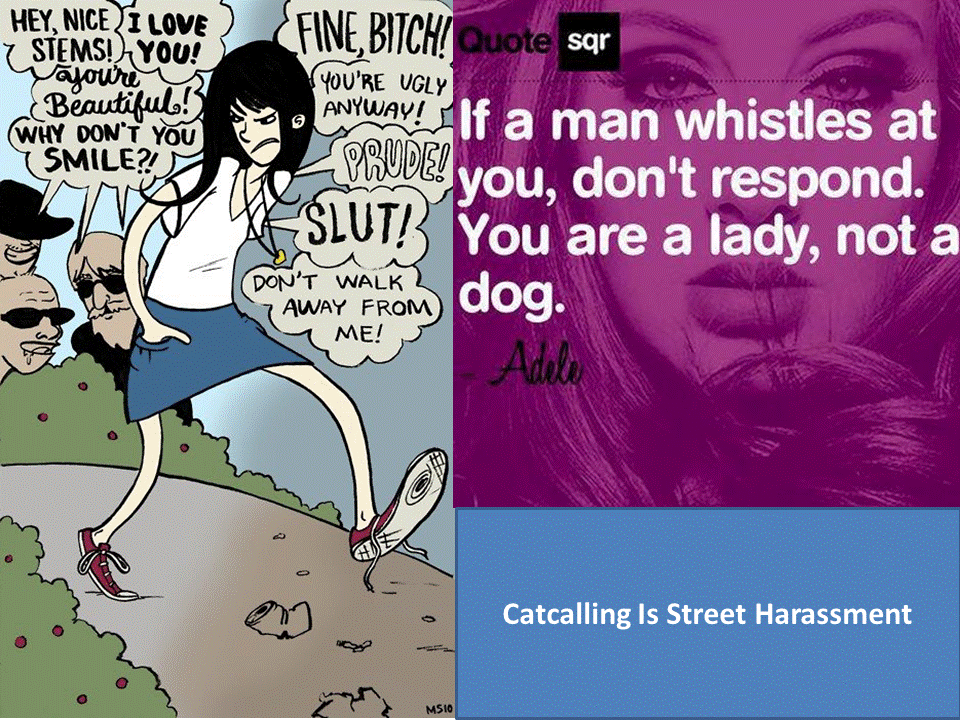
First of all, let’s call it what it is: street harassment. When guys on the street rudely approach or speak to women in demeaning ways that are unwanted, it’s harassment. However, many people are under the false impression that catcalling isn’t a big deal.

There’s a serious problem when people feel they can’t be who they are out of fear that they may be harassed. Many of the students in the USC video talked about how they felt the need to change their behavior. Some women said they changed their walking route so they would feel safer. Others talked about the need to change their clothing so guys don’t think they are “asking for it,” as many rape culture promoters like to say. One student in the video talked about how she went to great lengths to avoid her harassers, saying she was “active in creating [her] own invisibility and really adamant about being invisible to all men around [her].”

What kind of society do we create when people feel they have to somehow make themselves unseen in order to safely walk down the street?

Catcalling creates a power structure. Usually, it belittles a woman and reduces her to a sexual object in order for a man to feel he has a certain power. Street harassment is intimidating, it creates fear, and it’s embarrassing.

Yet, some people have this distorted idea that catcalling is a complement. One ignorant blogger, who must’ve somehow crowned himself an expert on how women think, said that women only pretend not to like catcalling. He wrote:

“…are you women so delicate that you can’t take a construction worker giving you a compliment…Grow up already! Though you’ll never admit it, even to yourself, you enjoy the attention.”

All I could think while reading his bullshit was, “Oh yes, please tell me more about how I crave my own commodification through rude comments from guys who were never taught manners!”

And yes, I’ll admit it: I do love attention. I do like complements. However, I prefer to be approached respectfully. Tell me I’m beautiful. Introduce yourself. Tell me you would like to take me to dinner. Offer me your number. Maybe I’ll give you mine. If I decline, don’t get mad—move right along.

If you can’t do that you’re not worth my time.

As blogger Anna Nettie Hanson of Girl Who Fought Back says, “Catcalls function as asshole identifiers.”

Now ladies, there are a few things we can do about street harassment. Some people say just ignore it—but really, we need to speak up. Ignoring the guy doesn’t teach him anything. He might speak the same way to the next woman he sees.

So here’s the best approach I can offer:

Step 1: Reject him. You don’t need a fool who talks to you like that (but of course you know that already).

Step 2: Call him out! Reeducate him. If you don’t do it nobody will, and he’ll just keep talking to women the old kind of same way. Break the Cycle!

Step 3: Confidently, with your head held high walk right on out of there. Show him that if he wants a woman of your sophistication, beauty, creativity, and intelligence, he’s gonna have to do better. Also, be proud that you were brave enough to speak up. Consider it your small form of  activism for the day.

I’m beyond tired of hearing “Aye Sexy,” “Where yo boyfriend at,” and all the variations. It’s time we put a stop to it.

To view the USC students’ video, click here.

IMPORTANT NOTE: I only suggest speaking up if you feel physically safe to do so. I know some guys do invade physical and personal space, in which case you know get out of there as fast as you can.